
Human Nature
Alex Hanimann
In collaboration with the Museum Villa dei Cedri in Bellinzona
13 March - 2 August 2026
The work of Alex Hanimann has been evolving on the Swiss art scene since the middle of the 1990s. As a matter of fact, it was at this precise time that the international scene that had held sway in the eighties started moving towards the demise of a season when such leading Swiss artists as Gertsch, Disler, Cahn, Stalder, Fischli/Weiss, Federer, Walker and many others had been involved in working beyond the borders of the confederation.
Alex Hanimann is fully entitled to be regarded as subscribing to the tradition – but also to the consequences – of this panorama, since he somehow represents that moment in history when a necessary requalification of language took place in the eighties, a time that was marked so strongly by such a considerable aggregative and collective energy as to give us now pause to reflect on those roaring years as something of a last avant-garde, characterised by the formation of common intentions: those were the years of the Transavant-garde and of the movement of the Neue Wilde, who not only constituted a way to reinterpret German Expressionism and the Fauves, but also included other cross-fertilisations within their numbers.
The artist from St Gallen belongs to the generation of creatives who are almost the orphans of a time that was heading towards the transition and uncertainty of an equally confused, fluid society, when the forms of grammar were undergoing change and the specific techniques of production were rarefying towards a transmediality that would cancel out previous criteria based on the relationship between medium and meaning, while marking the contemporary scene not as a force of the present so much as a future-oriented and futuristic form of new languages, at the very moment when new digital technologies were penetrating into artistic production worldwide.
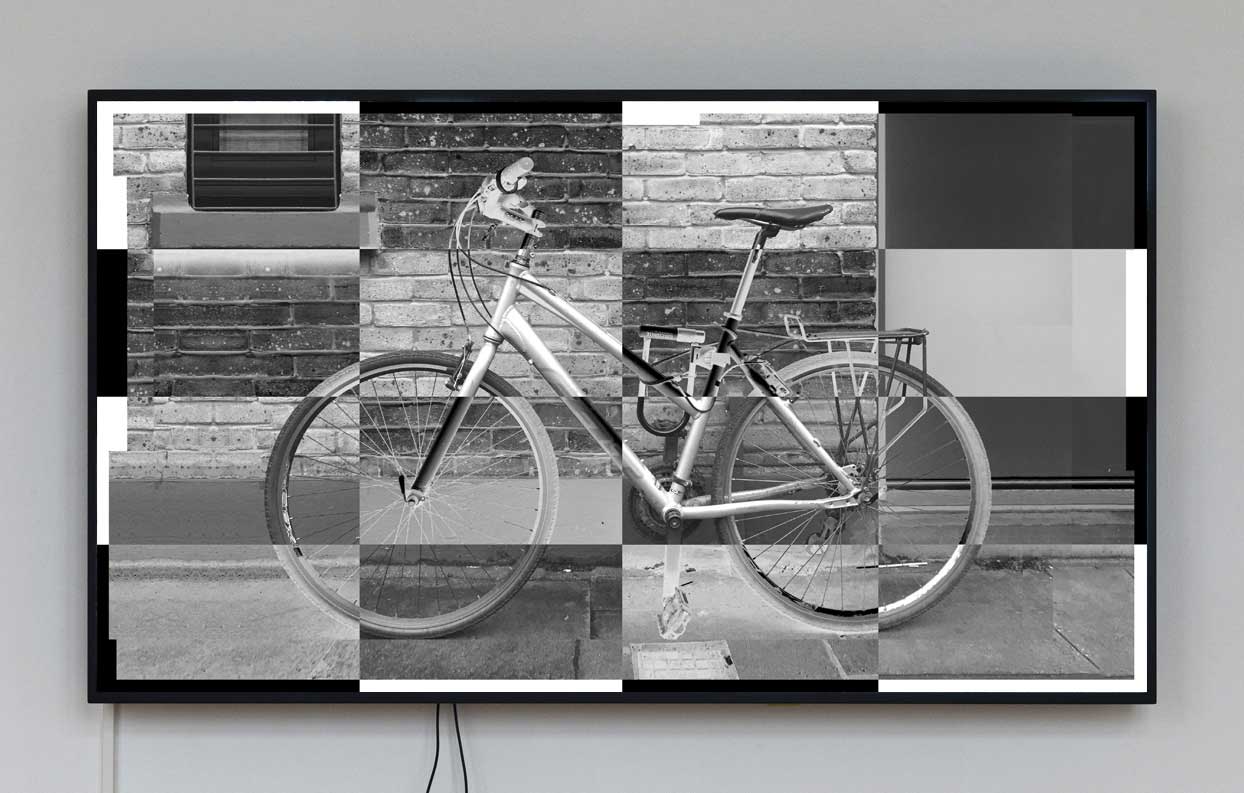
Although his practice of art was originally rooted in painting, Hanimann almost immediately broke the bounds of that stylistic medium, questioning it in its entirety, cross-fertilising its contents with spoken language (which is actually also a heritage of the Swiss tradition of graphic arts, whence he descends) and playing pleasantly with both meanings and significances, almost as though his were a planned art or a pack of cards, in which the interpretation of the image is at one and the same time a puzzle and/or a mirror of an increasingly virtual society, shorn of its character. It was this distinctive trait that also brought about his approach to the dimension of photography. From the archive of images captured through his lens in the course of the last twenty years, the artist has extracted such series as Wilderness, Driving as far as I can see and Maria, in which he combines issues and forms in compositions capable of conveying this foundation of his work. The aesthetic preponderance of these new virtual and digital technologies did the rest, as the artist has embodied the need finally to create a new platform of grammar and discussion about art in its relationship with form, and where the elements of a consumer society contribute to subduing awareness of the rapport between the absolutism of art and the triviality of the abundant representations of an everyday existence that is nourished by it. The obsessive, manic search for meaning behind the appearances of words and/or of representations – the distinguishing trait of Alex Hanimann’s artistic process – seems to be fated inevitably to end up in emptiness and anonymity.
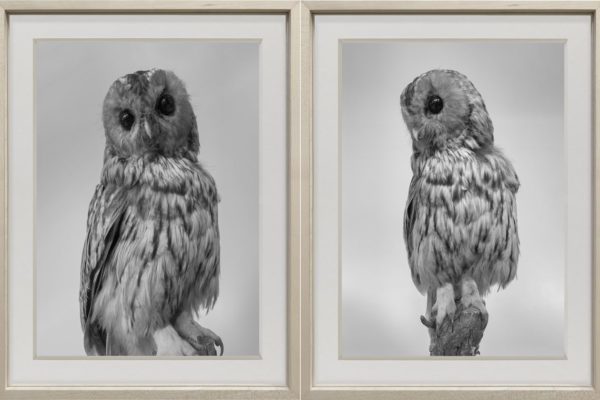
The exhibition in Bellinzona, which is being housed in two locations, the Museum of Villa dei Cedri and the MACT/CACT, also adopts a dual approach to tackling the fundamental issues at play in artistic tradition: landscape and the human figure. Not so much as descriptive elements, more as that philosophical attitude to nature that mankind inhabits and has always furnished. A nature that is almost too contaminated by man, one that he presents to us as one form of landscape. HUMAN NATURE, which Hanimann could be said to interpret as “nature as perceived by humans”, and at the same time the element unleashed on nature by man to corrupt it, encompasses both of these existential, interdependent aspects: the fact is that neither of them can exist and subsist without the other, as nature – now so irreversibly anthropised – accommodates man, who measures himself with and against it. Both have now become – for better or for worse – practically products, to which the artificial disposition of our communications society or artificial technologies attribute a sort of non-identity.
If uncontaminated nature is the missing link in this approach, then the human dimension and its redefinition in meta-contemporary society also stand out against a classical, anthropocentric representation, forging the space we need to ponder the public’s capacity to distinguish between reality and fiction. In times when social networking seems to have replaced old-world social relations and a certain approach to what is “real”, everything passes gradually through a process of abstraction, in which the representation of the human figure and its existential – but also its civil, social and even socio-political – dimension loses its primacy to a sort of dominant robotism that induces us to think again and redefine the concepts of identity and “gender”.
The way that Alex Hanimann’s work expounds on the theme of the transitory nature of the relationship between real society and political society is crystal clear, as is its attribution – whether right or wrong – of new forms of identity. Reflections about these two fundamental elements of life – man and nature – generally extend to take in all facets of humanity, not least that of our responsibility to maintain our knowledge and cognition of history.
Mario Casanova and Carole Haensler, Bellinzona, 2026.
Translated by Pete Kercher
Ph Alex Hanimann.
Where
MACT/CACT
Museo e Centro d’Arte Contemporanea Ticino
Via Tamaro 3, Bellinzona.
Opening hours
Friday, Saturday, Sunday
2 p.m. – 6 p.m.
Entry
CHF 6.00
Vernissage
Friday March 13, 2026, at 6:00 p.m.
at Villa dei Cedri Museum, Bellinzona.
At MACT/CACT the exhibition will be open
from 2:00 p.m. to 6:00 p.m. according
to the Museum’s regular opening hours.
