
27 January 2027. Visual considerations about Nazi-Fascist persecutions. Memory is History. The dark side of our conscience.
Jérémie Blanes / Marc Chagall / Hans Christiansen / Lovis Corinth / Ignaz Epper / Henri Epstein / Walter Helbig / Karl Jakob Hirsch / Erez Israeli / Willy Jaeckel / Richard Janthur / Béla Kádár / Paul Kleinschmidt / Rudi Lesser / Kurt Levy / Oskar Lüthy / Léo Maillet / Henny Mannheimer / Ludwig Meidner / Georg Merkel / Heinrich Müller / Otto Nebel / Meret Oppenheim / Richard Seewald / Milly Steger / Heinrich Tischler / Friedrich August Weinzheimer
From Europe to Palestine
Naftali Bezem / Yitzhak Frenkel / Osias Hofstätter / Aharon Kahana / Moshe Kupferman / David Lan-Bar / Reuven Rubin / Jakob Steinhardt / Hermann Struck / Igael Tumarkin
24 January - 18 April 2027
The commemoration of the Day of Memory falls on 27 January, the day when the Soviet army liberated the Nazi extermination camp at Auschwitz in 1945: the victims of the Holocaust and of Nazi-Fascism are now remembered every year on that date.
The MACT/CACT has decided to commemorate this day of contemplation by creating an exhibition of visual art, subscribing – albeit with a degree of curatorial license – to the theme of commemoration, while opening up to certain points of light or of discussion about situations and artists who, despite not having been involved directly with Nazi-Fascism, nevertheless suffered by reflection, as their activities in artistic and cultural fields were curtailed in the Germany of the day.
When Hitler came to power in 1933, he launched the Nazification of German culture and the systematic eradication of everything considered to be “Jewish” in Germany; the regime subjected every cultural institution to a process of political and ideological control and of Aryanisation, whose purpose was to deprive culture of its power and free thought of its oxygen: books were burned and teaching and lecturing posts were occupied by people appointed by the party apparatus. Everyone was controlled: every museum director was analysed and removed from office and replaced if found to be less than faithful. The historian Karl Schwarz (1885–1962), the founding director of Berlin’s first Jewish Museum (Jüdisches Museum Berlin), which was inaugurated in January 1933, emigrated in the same year to Tel Aviv in Palestine, where he directed the Tel Aviv Museum of Art, founded in the previous year, and added a significant driving force to the artistic and cultural activities of the future state of Israel.
It was in 1937 that Germany’s propaganda minister Joseph Goebbels promoted an exhibition organised by Adolf Ziegler, with the title “Entartete Kunst” (Degenerate Art), which was held in the same year first in Munich, then in other cities in Germany in the course of the year. The exhibition also provided the Nazis with the pretext for confiscating thousands of works of art from museums all over the country and from families, especially Jewish in faith, who were almost automatically considered to be considerate degenerate and dangerous for Germany’s youth and the country’s future, as well as works of enormous artistic and cultural value, which were sold to finance the wars that Hitler intended to launch, so as to extend the looming shadow of National Socialism all over Europe.
Kristallnacht (the Night of Broken Glass) in November 1938 marked the official launch of the pogrom campaign against everything Jewish in Germany, further exacerbating the regime’s already dire policies towards the Jews.
When Germany invaded Poland in 1939, the relevance of those policies became global and the fate of the Jewish people seemed to be sealed when the Wannsee conference was held in 1942: for culture in general and for the world as a whole the decade of Nazi rule constituted the darkest chapter in our recent history.
Looking now at the specifics of this exhibition, the MACT/CACT is encompassing a selection of artists whose works were considered to be “degenerate” by the Nazi regime. Many suffered the severe consequences of the Shoah and of Nazism themselves, including Henri Epstein, Karl Jakob Hirsch, Béla Kádár, Henriette Mannheimer and Heinrich Tischler, while others had to endure the disgrace of being forbidden to practise their art and to teach, as well as of exile, which often took them to Canton Ticino, where some, such as Epper, Helbig, Maillet and Seewald, found solace for the mind and the stimulus to start working again, above all in the area of Ascona and Monte Verità. Nazi-Fascism struck at everyone, without exception: painters, writers, musicians, architects and politicians, homosexuals and often just people who thought and lived differently. The long reach of Nazism did its utmost to uproot the values of Judaism in Europe – to some extent succeeding – by destroying symbols and practising the process of deportation and elimination.
We also added two young artists to this exhibition who have sometimes or often used their work to discuss issues related to the war or to the period of the Holocaust: Erez Israeli and Jérémie Blanes.
“From Europe Towards Palestine” is the title of the second section of this commemorative exhibition, showcasing the works of artists born in Europe and themselves Europeans in every respect, but who, as a consequence of Germany’s policy of Aryanisation, were obliged to emigrate to Palestine, some already as early as 1933.
It is always interesting to note how the flow of migration of European Jews towards Palestine forged an area of action of its own in an eastern setting and, for example, also to some extent strengthened the Bezalel Academy, which had been established in 1906 by Boris Schatz in Jerusalem, as well as the artistic and cultural environment in Palestine/Israel as a whole. In the midst of the enormous drama of that period in history, this phenomenon of great masses of people on the move certainly also channelled new and important forces in the fields of the sciences, the arts and architecture towards the future state of Israel: we need only mention the considerable concentration of Bauhaus architecture in Tel Aviv or the research hubs established there in the areas of medicine and other sciences. And the same also applies to the arts.
Never as in the case of the National Socialism of Hitler’s Germany have anti-Jewish policies, deportation and racial laws constituted such a drastic cultural deprivation for an entire country.
Mario Casanova, Bellinzona, 2026.
Translation by Pete Kercher
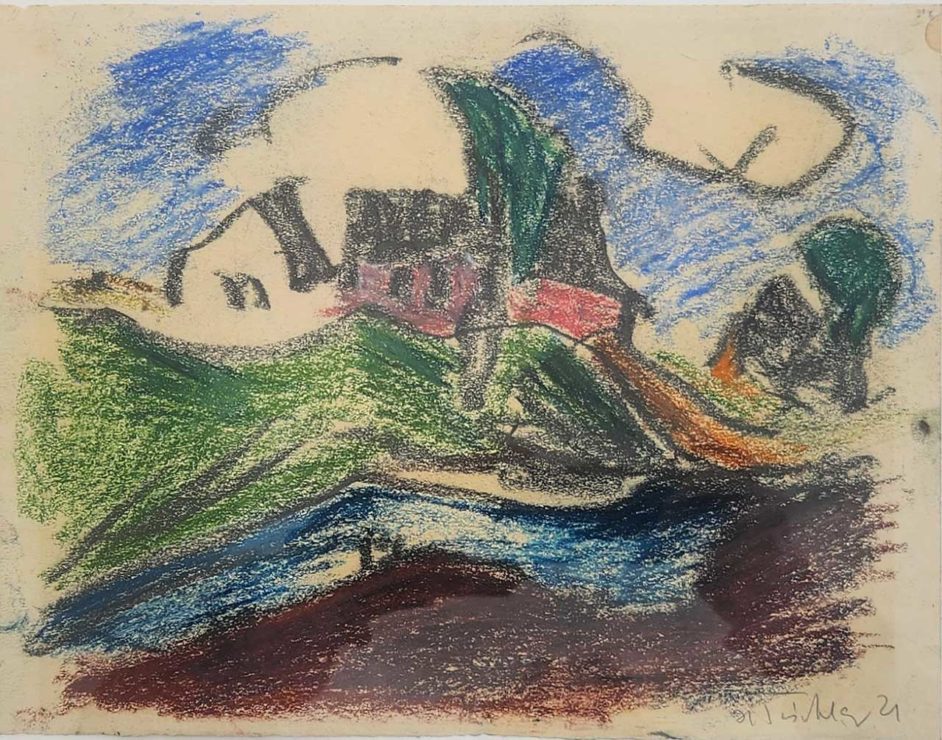
- Heinrich Tischler (1892-1938), Landscape with Road, 1921. Pastel on paper, signed and dated lower right, 20 x 29 cm. Private collection, Switzerland.
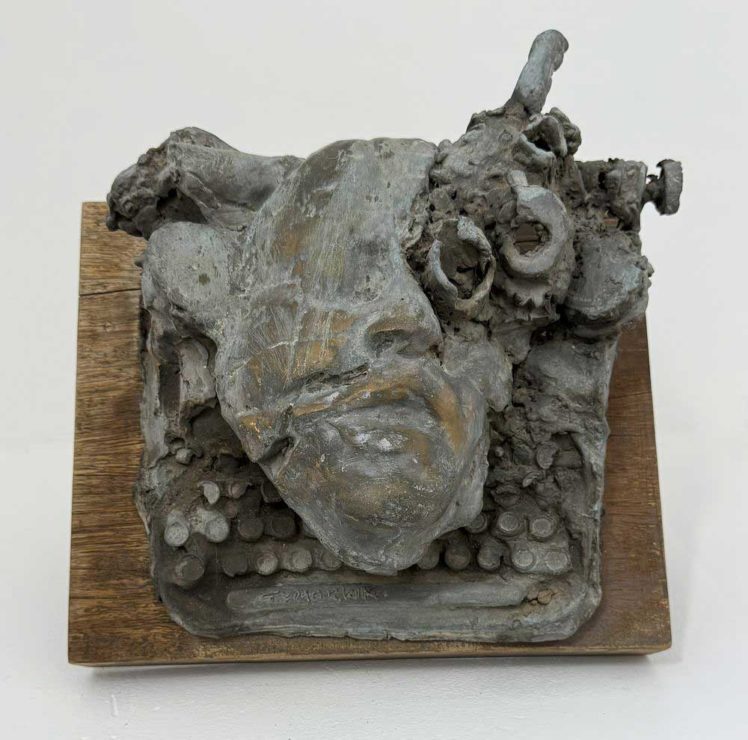
- Igael Tumarkin (1933-2021), Self-Portrait, late 1960s. Bronze sculpture on a wooden base, signed in the bronze on the front, 31 x 36 x 19 cm. Private collection, Switzerland.
Where
MACT/CACT
Museo e Centro d’Arte Contemporanea Ticino
Via Tamaro 3, Bellinzona.
Opening hours
Friday, Saturday, Sunday
2 p.m. – 6 p.m.
Entry
CHF 6.00
Vernissage
Saturday, January 23, 2027, at 5-30 p.m.
