
New works from the stores
Naftali Bezem / Martin Disler / Michael Druks / Georg Einbeck / Oded Feingersh / Yitzhak Frenkel / Moshe Gershuni / Horst Janssen / Moshe Kupferman / Uri Lifshitz / Max von Moos / Rudolf Mumprecht / Avshalom Okashi / Leo Roth / Meir Steingold
13 March - 10 May 2026
When a museum sets out to draw comparisons between History and the present day, their collections furnish the material that conveys historical knowledge and awareness.
In the last ten years, the deterioration of the political situation of the world has obliged more than one art location to think more profoundly about the events of the past, the better – perhaps – to anticipate and understand certain dark sides of a present that is about to unfold.
First the war in Ukraine, then the pogrom in Israel in 2023, then again the rapid evolution of the situation today in Iran or in South America… all of these have certainly brought us to a terrain of reflection, not least the one around the calls emanating from ideology and political propaganda, whose paths are prepared and facilitated by today’s digital social media. The world and its history seem to be, once again, in danger and under pressure. And museums seem to be more aware of discussions about History, in which they take part through the means of the element most conducive to them: their stores of objects and works of art and the historical witness they bear.
Within the framework of the global political debate, the recurring issues of discussion about such questions as multiculturalism and inclusion that are so dear to progressive circles have driven the analysis of several historical events towards the rocks of dangerous and perilously unjust reefs, such as the effects of the cancel culture movement, with its penchant for demolishing or denying historical memory, whose analytical shortcomings make provision for – and insist vociferously on – the replacement of everything it considers even only merely offensive, if not actually dangerous, for the evolution and education of future generations, acting as a catalyst towards the utter elimination of elements of which future generations are thus doomed to remain in complete ignorance. And it is once again the perilousness of politics, with all its theatricals and all its fanfares, that decides what is and what is not “just”, always on the basis of each grouping’s respective ideologies, whose very survival is once again decreed by the party-political organisation of modern political regimes.
Culture and history are like energy: they cannot be cancelled, nor can they be destroyed, but must be analysed and understood, if not always justified, and re-interpreted and adapted to an evolving context.
For several years now, the events organised by the MACT/CACT have been shifting gradually towards increased reflections about the period that goes from the end of the nineteenth to the early decades of the twentieth centuries, with a special focus on how European society already started drifting at the dawn of the twentieth century towards the dark years of Nazi-Fascism, when bipolar conflicts created surges of dramatic politics. It is from this period of time that we have for now chosen, for our specific focus, certain questions that have inevitably come up for discussion once again.
What responses does the world of culture offer in real life? Since that political bipolarism can also be found in artistic circles, would it be possible to frame this discussion in terms of a right-wing culture and another that looks across at it from the left wing? Such borders do in fact exist in the field of museums and the institutions, and everyone who has ever had dealings with what we can call “regime culture” – or with art in public spaces – knows this only too well.
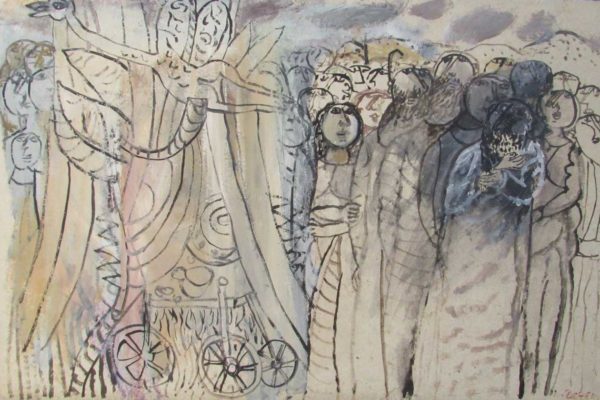
The exhibition NEW WORKS FROM THE STORES is not a politically-flavoured show (nor does the title suggest as much), since the artists are themselves already the bearers of this form of creativity, which is made in many ways revolutionary by its vigorous potential for abstraction, regardless of the historical context of the moment. The selection made by the curator is a chequerboard of authors and works that had never before been shown in the Centre. Yet chance is marginal when compared to causality, which sets out to reconstruct a track of historical coherence.
Mario Casanova, Bellinzona, 2025.
Translated by Pete Kercher
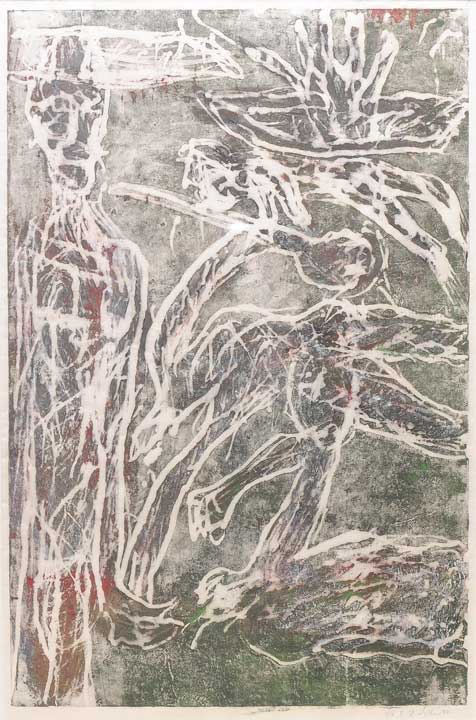
Martin Disler (1949-1996), Untitled, 1990. Colour woodcut, numbered 3/6, signed and dated lower right, 93 x 61 cm. Private collection, Switzerland.
Where
MACT/CACT
Museo e Centro d’Arte Contemporanea Ticino
Via Tamaro 3, Bellinzona.
Opening hours
Friday, Saturday, Sunday
2 p.m. – 6 p.m.
Admission
CHF 6.00
